There are 180 million Christ-following entrepreneurs worldwide, and 99.7% of them are building alone, without access to a Christian organization designed to serve them (Faith Driven Entrepreneur, 2025). That is both a remarkable gap and a remarkable opportunity.
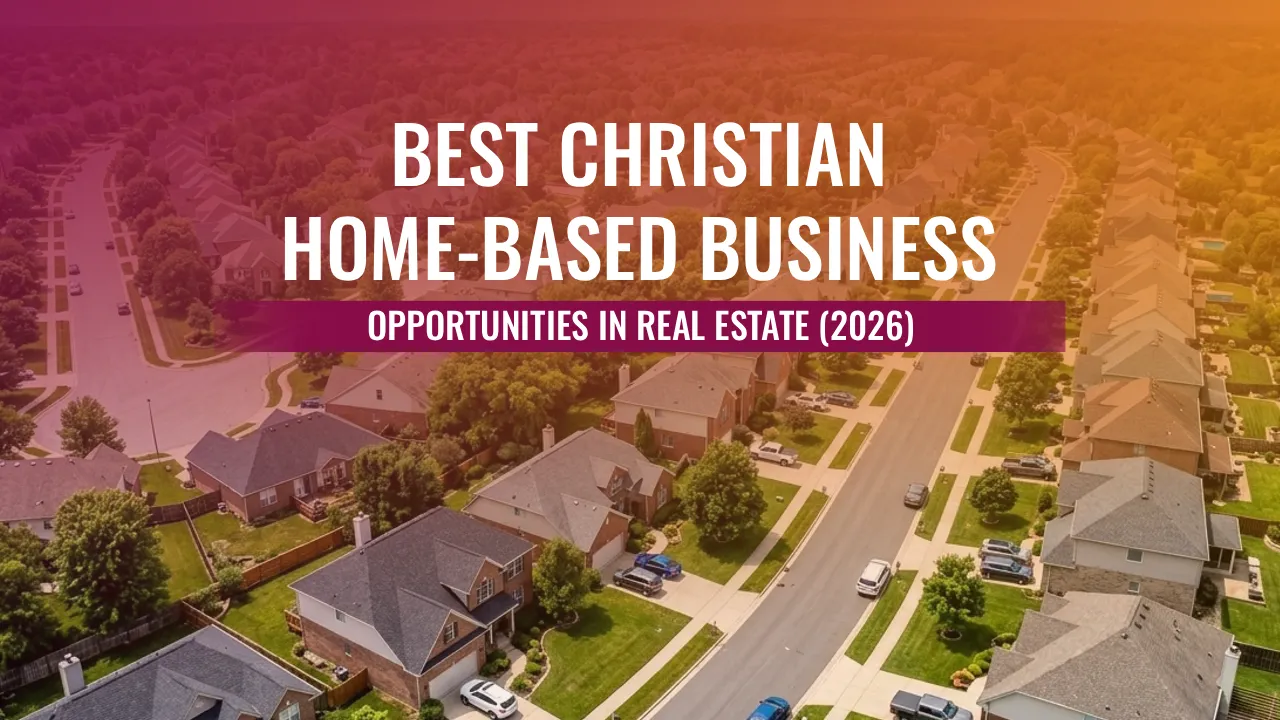
For Christians who want to build a home-based business, real estate has a particular appeal. The income ceiling is high, the schedule is flexible, many strategies require no license, and done well it creates genuine value for every person in the transaction. That last point matters more to a faith-driven investor than it might to someone building purely for profit.
But not every real estate model aligns equally with biblical stewardship principles. Some strategies are extractive by design. Others create value for sellers, communities, and investors alike. Knowing the difference is the first decision a Christian entrepreneur should make before choosing which opportunity to pursue.
Key Takeaways
- 180 million Christians worldwide are entrepreneurs, but only 0.3% have access to faith-aligned business support (Faith Driven Entrepreneur, 2025).
- Real estate is one of the highest-potential home-based business categories for Christians: no license required for many investor strategies, flexible schedule, scalable income.
- Biblical stewardship principles (the Parable of the Talents, Proverbs on diligence, Ecclesiastes on diversification) provide a coherent framework for real estate investing decisions.
- The difference between a Kingdom business and a profitable business is not the deal structure. It is the decision-making framework behind every transaction.
- Kingdom 320 is purpose-built for Christian investors who want both business results and Kingdom purpose from the same work.
New to Kingdom 320? Here’s what Kingdom 320 is before you explore the opportunities below.
Why Real Estate Is One of the Best Home-Based Business Categories for Christians
Starting a business from home removes many of the traditional barriers: no storefront, no commute, no boss. For Christians specifically, it also removes a common tension: you are not navigating workplace cultures that conflict with your values, because you are building the culture yourself.
Real estate, compared to other home-based business options, offers several specific advantages:
No license required for investing strategies. Wholesaling, creative financing, and buy-and-hold investing do not require a real estate license in most states. You can start building a business this week without waiting months for credential approval.
Scalable from zero. Wholesale real estate (finding off-market deals and connecting sellers with buyers) can be started with minimal capital. The first deals often require more hustle than money.
Location independence. With the right systems, a real estate investing business can be operated from home and scaled without a physical office. Many of Kingdom 320’s 30,000+ students run their investing businesses entirely remotely.
Genuine impact. Done with integrity, real estate investing creates real value: distressed sellers get a fair solution, communities get improved properties, and investors build generational wealth that can fund Kingdom purposes beyond the deal itself.
The Most Viable Faith-Aligned Real Estate Opportunities
1. Wholesale Real Estate
Wholesaling is finding a motivated seller, putting the property under contract, and then assigning that contract to a cash buyer for a fee (typically $5,000 to $25,000 per deal) without ever taking ownership of the property.
It is the most accessible entry point for Christian home-based investors because it requires minimal capital and no license. The biblical alignment question here is straightforward: are you serving the seller fairly? A Kingdom-minded wholesaler brings a genuine solution to a distressed situation, not a lowball predicated on desperation. The difference is the framework behind the offer, not the offer structure itself.
Jeff Rutkowski’s reverse wholesaling methodology at Kingdom 320 addresses this directly: building the buyer network first, so you make offers with certainty and fair terms, not offers driven by fear of not closing.
(Want the story behind that methodology? Here’s more on Jeff Rutkowski, or see how the software supports reverse wholesaling.)
2. Creative Financing / Subject-To Investing
Subject-To investing means acquiring a property subject to the existing mortgage: you take control of the property and make the mortgage payments, without formally assuming the loan. For sellers in distress, this provides immediate relief. For investors, it provides a path to ownership without conventional financing.
The biblical stewardship principle that governs this strategy is honesty and full disclosure. A seller must genuinely understand the agreement they are entering. Christian investors who operate in this space with transparency and care for the seller build both a sustainable business and a reputation that compounds over time.
3. Fix and Flip
Buying distressed properties, renovating them, and selling them adds real value to communities: improving housing stock, improving neighborhoods, and creating economic activity for contractors and service providers.
The faith alignment concern here is stewardship of capital and fair dealing with sellers. Over-leveraging on multiple flips at once is a form of presuming on tomorrow that Proverbs cautions against (“Wealth gained hastily will dwindle,” Proverbs 13:11 NIV). A disciplined, deal-by-deal approach that counts the cost before committing, as Luke 14:28 instructs, is both biblically sound and financially prudent.
4. Buy-and-Hold / Long-Term Rental
Long-term rentals are the classic wealth-building vehicle: acquire, rent, appreciate, refinance, repeat. Ecclesiastes 11:2 advises diversifying investments across seven or eight ventures because you do not know which will succeed. A portfolio of rental properties is a direct application of that principle.
For Christian landlords, the opportunity to be a just and fair provider of housing, maintaining properties well, treating tenants with dignity, and managing disputes with integrity is itself a form of ministry. Colossians 3:23 (“Whatever you do, work at it with all your heart, as working for the Lord”) applies as much to property maintenance as to pulpit work.
5. Real Estate Coaching (for Experienced Investors)
Once you have built a working system and documented deal outcomes, teaching others the same path is a natural progression, and one with significant income potential. See our guide on how to become a certified real estate coach for the full path.
For Christian investors specifically, coaching carries a particular calling: you are not just transferring a skill set. You are helping people build stewardship capacity, overcome fear, and use their resources for Kingdom purposes. That is work with eternal weight.
What Makes a Business “Kingdom-Aligned” vs. Just Profitable
This is the question most Christian business resources avoid because the answer is harder than it looks.
A business is Kingdom-aligned not when it quotes Scripture in its marketing, closes on Sundays, or donates 10% of profit to a church, though those things may be true of Kingdom businesses. It is Kingdom-aligned when the decision-making framework behind every transaction reflects biblical stewardship principles: honesty with sellers, fair dealing with buyers, diligence in execution, generosity with profit, and an awareness that the wealth generated belongs ultimately to God and is being managed on His behalf.
The Parable of the Talents (Matthew 25:14-30) is the clearest biblical framework for real estate investing. The master entrusts different amounts to three servants. Two invest and double their resources. One buries his out of fear. The reward is not for the servants who earned the most. It is for the ones who were faithful with what they were given. The fearful servant’s problem was not laziness. It was a distorted view of the master (seeing him as harsh rather than generous) that produced paralysis instead of stewardship.
Fear is the most common reason Christian investors do not act on what they know. The antidote is not more information. It is a community of believers who normalize Kingdom-purposed investing and a system that removes the guesswork from the first step.
Wondering whether that kind of community and system fits you? See who Kingdom 320 is for.
Kingdom 320: The Program Built for This
Kingdom 320 is not a real estate program with a Christian branding layer. It is a faith-integrated investing system built by Jeff Rutkowski over 20+ years of active investing, guided by the conviction that real estate is one of the clearest modern applications of the Parable of the Talents.
The curriculum teaches the reverse wholesaling system. The coaching applies it to your specific market and situation. The community of 30,000+ faith-driven investors provides the peer environment where Kingdom-purposed investing is the norm.
For the step-by-step on how those pieces fit together, see how it works.
The real estate coaching program and the real estate training software work together in one integrated membership designed for the Christian entrepreneur who wants to build a real estate business from home without compromising the values that make the business worth building.
If you are exploring the program, start with the free masterclass at kingdom320business.com. No sales call required before you see the full system.
Faith-driven entrepreneurship is an empirically distinct category. Research from Springer Nature’s 2024 work on Christian faith-based firms identifies key differentiators from secular firms: servant leadership culture, community benefit as an explicit objective, and ethics embedded in operational decisions rather than treated as a compliance layer. Real estate, as one of the most relationship-intensive industries, offers unique scope for these principles to show up in every transaction. (Faith-Based Entrepreneurship, Springer Nature 2024; Faith Driven Entrepreneur, 2025)
Frequently Asked Questions
What is the best home-based business opportunity for a Christian?
Real estate investing, particularly wholesale and creative financing, consistently ranks as one of the highest-potential home-based business categories for Christians because it requires no license, can be started with minimal capital, offers significant income upside, and creates genuine value in every deal when done with integrity. Kingdom 320’s program is built specifically for this path.
Do I need a real estate license to start a Christian real estate business?
No. Wholesale real estate, creative financing, and buy-and-hold investing do not require a license in most states. You can begin building a real estate investing business today without waiting for credential approval.
How does faith affect real estate investing decisions?
Faith primarily shapes the decision-making framework, not the deal structure. A biblically grounded investor approaches distressed sellers with genuine care for their situation, makes offers with full transparency, counts the cost before committing to a deal, and manages profit as a steward rather than an owner. These principles produce both better ethics and better business: long-term reputation and referral networks that secular programs cannot replicate. For a deeper look at the biblical foundation, see our post on what the Bible says about investing. (Learn more about the company on the About Kingdom 320 page.)