

Wholesale real estate gets talked about a lot in investing circles, but rarely explained clearly. Some people think it sounds too good to be true. Others have a vague understanding of the concept but no clear picture of how a deal actually moves from start to finish.
Let me give you that clarity.
Wholesaling is one of the most legitimate and accessible entry points into real estate investing. It does not require you to own property. It does not require a license in most states. And it does not require significant starting capital. What it does require is effort, consistency, and a solid understanding of how deals are found, evaluated, and closed.
I have taught thousands of students to close their first wholesale deal, and many of them had no prior real estate experience and no meaningful savings when they started. Read more about my background and why I teach this. The strategy works. But it works the way every real strategy works: when you actually apply it.
Key Takeaways
- Wholesaling is the process of finding discounted properties, getting them under contract, and assigning that contract to a cash buyer for a fee
- The national average wholesale assignment fee is $13,000, with a typical range of $5,000 to $20,000 per deal (Real Estate Bees, 2026 survey of 1,000+ wholesalers)
- Beginner wholesalers typically close 3 to 6 deals in their first year; intermediates close 8 to 12
- You never need to buy the property; you are selling the right to purchase it
- Mentorship dramatically accelerates your first deal timeline by eliminating the most common and costly beginner mistakes
What Wholesale Real Estate Actually Is
Here is the simplest definition: you find a motivated seller and agree on a discounted price, put the home under contract, and then assign that contract (not the property) to an investor buyer for a fee. That fee is your profit.
Read that again carefully, because this is the part that confuses most beginners. You are not buying the house. You are buying the right to buy the house, at a specific price, within a specific timeframe. Then you are selling that right to someone else who actually wants to buy and either renovate or rent the property.
The difference between the price you have the property under contract for and the price your buyer agrees to pay is your assignment fee. That is your profit on the deal.
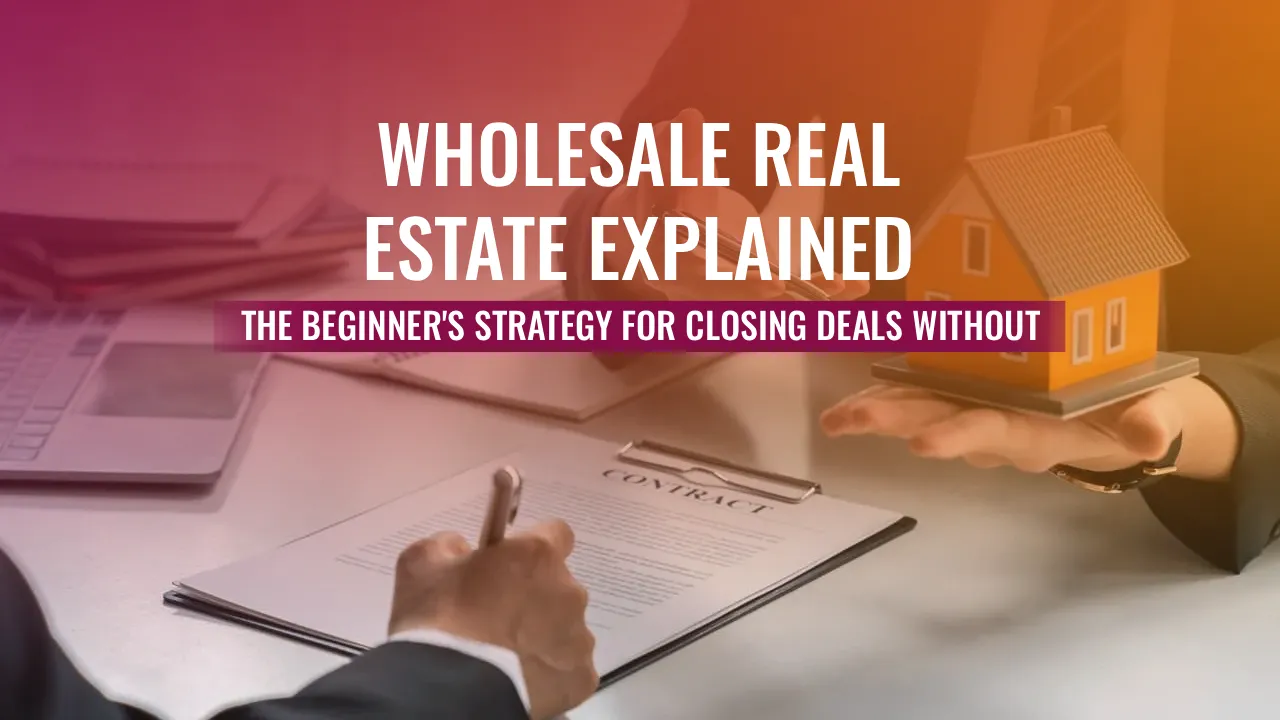
Wholesaling real estate for beginners is the process of putting a discounted property under contract and then assigning that contract to a cash buyer for a fee, without ever buying the property yourself.
Why Motivated Sellers Accept Discounted Prices
This is the question most beginners ask first, and it is a fair one. Why would any seller accept less than market value for their property?
The answer is that not every seller’s primary goal is maximum price. Some sellers need speed far more than they need top dollar.
The first step in wholesaling is finding motivated sellers: people who need to sell quickly and are willing to accept a discounted price in exchange for speed and convenience. These sellers are often in distress, facing situations like foreclosure, divorce, inherited property, tax liens, or relocation on a tight timeline.
A seller facing foreclosure in 45 days cannot wait 6 months for a retail buyer who needs to secure financing and negotiate repairs. A seller who inherited a property in another state and does not want to manage it cannot afford to have it sitting vacant and draining maintenance costs while they list it on the MLS.
Your value proposition as a wholesaler is simple: you close fast, you buy as-is, and you provide certainty. For the right seller, that combination is worth more than a higher price with uncertainty attached.
How a Wholesale Deal Works: Step by Step
Step 1: Find a Motivated Seller
Lead generation is the engine of any wholesale business. The strategies include direct mail campaigns to distressed property owners, cold calling from skip-traced lists, driving for dollars (physically identifying neglected properties in your target area), digital advertising to motivated seller landing pages, and networking with probate attorneys, divorce attorneys, and real estate agents who encounter distressed situations.
The key is consistency. Wholesale deals come from pipeline volume. Most experienced wholesalers talk to dozens of sellers before finding one whose situation and price expectations align with a deal that works.
Step 2: Analyze the Deal
Before you make an offer, you need two numbers. The After Repair Value (ARV), which is what the property will be worth after a buyer renovates it, and the estimated cost of repairs.
The standard formula most wholesalers use is the Maximum Allowable Offer (MAO): ARV multiplied by 70%, minus estimated repair costs, minus your assignment fee. The 70% factor leaves room for the cash buyer’s profit margin and closing costs.
Example: If a property’s ARV is $200,000 and repairs are estimated at $30,000, and you want a $15,000 assignment fee, your offer to the seller should be no higher than $95,000. ($200,000 x 0.70 = $140,000, minus $30,000 repairs, minus $15,000 fee = $95,000.)
Step 3: Get the Property Under Contract
Negotiate a purchase agreement that allows you to assign the contract. Make sure the terms are fair and make sense for a good resale. Your purchase contract needs two critical clauses: an inspection contingency that allows you to cancel if unexpected problems arise, and an assignment clause that confirms you have the right to assign the contract to another buyer.
Typical earnest money for a wholesale contract runs $500 to $2,000. You are not putting up the full purchase price, just a good-faith deposit that demonstrates you are serious.
Step 4: Find Your Cash Buyer
Immediately start contacting your cash buyer list. Send them the property details, your analysis, photos, and the assignment fee you are charging. Your cash buyer list is built by networking with local investors, attending Real Estate Investor Association meetings, connecting with hard money lenders who know their borrowers, and marketing your deals through investor-focused platforms.
The strongest wholesalers build their buyer list before they have deals. That way, when a deal comes in, they are not scrambling to find someone; they are making a phone call to a person who already trusts their analysis.
Step 5: Assign the Contract and Close
Transfer the purchase agreement to a buyer for an assignment fee, with the buyer agreeing to your terms in writing. Then meet with a title company or real estate attorney to ensure the transaction is legal and properly structured.
The title company handles the closing and distributes funds. Your assignment fee is paid at closing. The buyer takes ownership and proceeds with their renovation or rental plan.
What You Can Realistically Earn
Let me give you honest numbers here, because the internet is full of people claiming they made $100,000 on their first wholesale deal.
A typical assignment fee runs $5,000 to $20,000, with the national average around $13,000 per deal according to the largest industry survey of over 1,000 professional wholesalers. There is no fixed wholesale real estate salary; wholesalers get paid per deal, not by paycheck.
Beginner wholesalers typically earn $2,000 to $5,000 per transaction as they develop market knowledge and establish buyer networks, closing 3 to 6 deals annually for total income of $10,000 to $30,000. Intermediate wholesalers with 1 to 3 years of experience average $7,500 per deal, completing 8 to 12 transactions yearly for $60,000 to $100,000 in annual earnings.
The math beyond intermediate level: two deals per month at $10,000 each is $240,000 per year. Four deals per month reaches $480,000. Those are real numbers that experienced, systematic wholesalers produce, but they come after months of building systems, a reliable buyer network, and consistent lead flow.
Your first deal will likely be smaller than average and take longer than you expect. That is normal. It is also the most valuable deal you will ever do, because it teaches you everything the next twenty will build on.
The 3 Most Common Beginner Mistakes
Overestimating ARV
New wholesalers frequently pull optimistic comparable sales. They find the highest-priced comparable in the neighborhood rather than the most representative one, which makes their deal numbers look better than they are. Your cash buyers will catch this. If your ARV is wrong, your offer is wrong, and your deal falls apart at the point of assignment. Learn to pull conservative, accurate comps from the start.
Underestimating Repair Costs
The second most common error. Beginners look at a distressed property and estimate $20,000 in repairs when the actual number is $45,000. The solution is to walk every deal with an experienced contractor or investor before you make an offer. That extra step on your first 10 deals will save you from deals that collapse and sellers who feel misled.
Not Building a Buyer List First
Finding deals without buyers means you are scrambling to find someone to assign the contract to before your closing deadline expires. Build relationships with cash buyers before you need them. Attend local REIA meetings. Connect with hard money lenders. Know who your buyers are before you go out looking for their deals.
Do You Need a License to Wholesale?
This question has a more nuanced answer in 2026 than it did five years ago.
Six states enacted new wholesaling laws in 2025 requiring enhanced disclosure, and 10 states now require licensing after one or two assignments. The states with new requirements in 2025 include Connecticut, Maryland, Pennsylvania, Tennessee, Oklahoma, and North Dakota.
In most states, wholesaling remains legal without a license, provided you are assigning contracts rather than representing parties as an agent. But you must know your state’s current laws before you start. Real estate regulations change, and operating outside the law in any state creates significant liability.
The safest approach is to consult with a local real estate attorney who understands your state’s current wholesaling regulations before you submit your first contract. That one-hour consultation is worth far more than the cost. If you are weighing wholesaling against getting licensed and building a career as an agent instead, our real estate agent coaching program covers that path in detail.
How Mentorship Accelerates Your First Deal
The most consistent pattern I have seen across thousands of Kingdom 320 students is this: the ones who close their first deal in 60 to 90 days are almost always the ones who had a mentor helping them evaluate deals, check their analysis, and hold them accountable to daily lead-generation activity.
The ones who take 12 to 18 months (or never close a deal at all) are usually trying to figure it all out on their own, consuming more content when they hit a wall instead of getting feedback from someone who has been there.
A real mentor focuses on how wholesaling works at an atomic level. They hold you accountable to daily lead-generation metrics and deal-analysis discipline. A professional mentorship program provides a community of active buyers and proprietary deal-finding tools you simply cannot get on your own.
That accountability matters more than most people admit before they are inside a coaching program. The information exists online. What changes your timeline is having someone who expects you to show up, submit offers, and do the work between sessions.
For a full picture of what a quality mentorship program includes and how to evaluate one, see our real estate investing coaching program guide.
Frequently Asked Questions
Is wholesale real estate legal?
Yes, in most states, though regulations vary and are evolving. The core mechanics of wholesaling (finding deals, contracting with sellers, assigning contracts to buyers) are legal in the majority of US states. Some states have enacted disclosure requirements or licensing thresholds. Always verify your state’s current regulations with a local real estate attorney before starting.
How much do beginner wholesalers make?
Beginner wholesalers typically earn $2,000 to $5,000 per transaction, closing 3 to 6 deals in their first year for total income of $10,000 to $30,000. Fees grow as your market knowledge, buyer network, and deal-evaluation skills develop. First-year income is volatile, so plan for it and do not treat early slow months as evidence that the strategy does not work.
How long does it take to close a first wholesale deal?
With focused lead generation, consistent follow-up, and a mentor guiding your deal analysis, most motivated students close their first wholesale deal within 90 to 180 days. The timeline extends significantly without structured accountability. Students who wait to feel fully ready before generating leads typically take 6 to 12 months longer than those who start immediately.
Can I wholesale real estate without any money?
Nearly. You need $500 to $2,000 for earnest money on your first contract, and a modest budget for basic marketing. Some investors find partners or use assignable contracts that do not require earnest money in certain markets. The capital requirement for wholesaling is far lower than any other real estate investment strategy, which is the primary reason it is the recommended starting point for investors with limited savings.
What is the best market for wholesaling?
Markets with high concentrations of distressed properties, active cash buyers, and motivated seller situations tend to produce the best wholesale opportunities. Midwest markets like Cleveland, Detroit, Indianapolis, and Kansas City have historically been strong wholesale markets due to lower price points and active investor communities. That said, successful wholesalers operate in every major US market: the strategy adapts to local conditions rather than depending on a specific geography.
Wholesale real estate is not a get-rich-quick scheme. It is a legitimate, learnable strategy that lets you generate real income from real estate without owning property, without significant starting capital, and without a license in most states.
What it requires is education, effort, and someone who can help you avoid the mistakes that derail most beginners before they close their first deal. Learn more about what Kingdom 320 is and the mission behind it on our About page.
If you want to learn the specific system Kingdom 320 teaches for finding motivated sellers, evaluating deals accurately, and building a cash buyer network, watch Jeff’s free 90-minute training. You can also go deeper on the investor path in our guide to what real estate investing is and how to start.